6.18.26 Tredas Weekly Recap
Weekly Action:
Jul26 Corn up 4 at $4.1750
Jul26 Beans up 8 at $11.22
Jul26 Chi Wheat up 20.5 at $6.05
Jul26 KC Wheat up 8 at $6.4250
Jul26 Cotton up308 points at $0.7602/lb
July26 Hogs down $2.425 at $95.025
June26 Fats up $4.925 to $254.800
Aug26 Feeders up $9.175 to $366.600
Dec26 Corn up 4 at $4.4425
Nov26 Beans up 10 at $11.42
Sep26 Chi Wheat up 17.5 at $6.1325
Sep26 KC Wheat up 9.25 at $6.50
Dec26 Cotton up 331 points at $0.7973/lb
In observance of Juneteenth, markets will be closed Friday, June 19th.
Grains:
Grains spent most of the week on the defensive as generally favorable weather, improving crop conditions, and ongoing pressure from fund liquidation kept a lid on rallies.
This week's USDA export sales report was positive for the grain markets, with corn continuing to be the bright spot. Corn export demand remains strong and is running well ahead of the pace needed to hit USDA's current projections, helping offset some of the pressure from favorable weather and expectations for a large crop. Soybean sales were fairly routine, but the market got a boost from rumors of Chinese buying that started circulating on Tuesday. That optimism carried into Wednesday when USDA announced a 264,000 metric ton new-crop soybean sale to an unknown destination, followed by a 132,000 metric ton new-crop sale to China and another 120,000 metric ton new-crop sale to an unknown buyer. While wheat export demand remains more of a mixed bag, the recent soybean purchases were a welcome reminder that demand is still showing up, especially with new-crop prices sitting near the lower end of this year's range.
Monday’s crop progress report was pretty much in line with expectations. Corn came in at 68% good-to-excellent, matching trade estimates and up a point from last week’s 67%, although still below last year’s 72%. Soybeans were rated 66% good-to-excellent, also right on expectations and up from 65% last week, putting them even with last year’s rating.
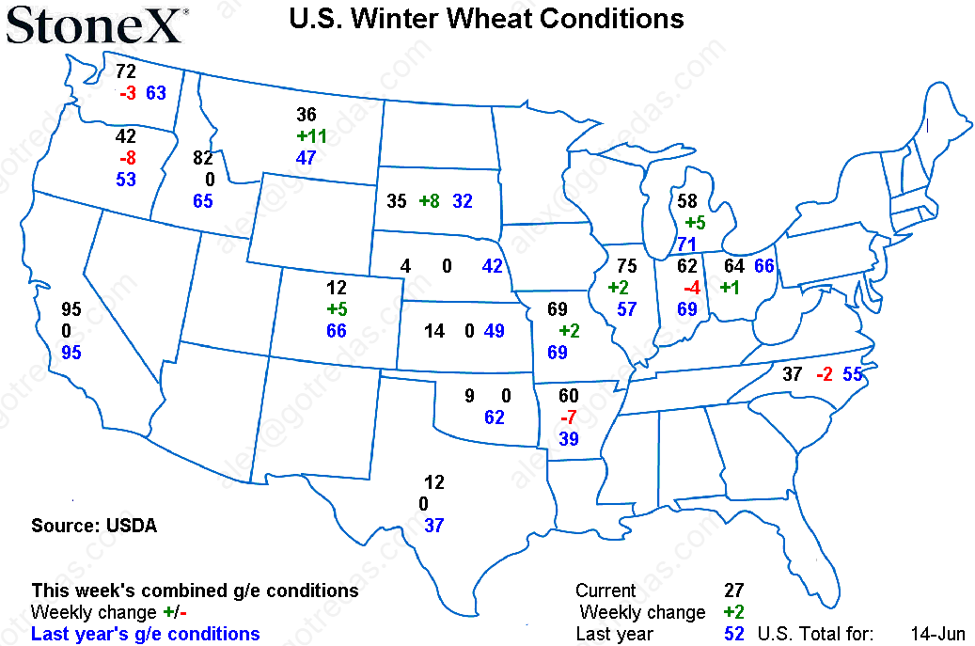
Winter wheat improved as well, coming in at 27% good-to-excellent versus 25% last week and slightly better than the average trade guess. Even with the improvement, winter wheat conditions remain well behind last year’s 52% good-to-excellent rating.
Overall, the report continues to show a crop that is generally off to a solid start, with corn and soybean conditions holding steady to improving across much of the country, while the wheat crop continues to be the ugly duckling of the bunch.


Basis:
Old Crop Corn Basis

Old Crop Bean Basis

Livestock:
Livestock markets had another solid week, with both live and feeder cattle continuing to work back toward contract highs. Tight cattle numbers and strong demand are still providing plenty of support, while lower feed costs have helped boost feeder cattle values. Cash cattle trade remained firm, and buyers continue to stay aggressive in securing inventory. Hog futures were a little more mixed, but overall the livestock complex remains on strong footing. While the trend is still friendly, these historically high price levels can lead to some sharp swings, making risk management worth keeping on the radar.

Weather:
Forecasts remain largely favorable across the Corn Belt over the next 10 days. Temperatures are expected to average near normal to slightly below normal across much of the Midwest, with highs generally ranging from the upper 70s to mid-80s. Rain chances remain active, with most areas forecast to receive between 0.75 and 2.00 inches of precipitation, while localized thunderstorms could bring heavier totals.


Economy:
The Fed wrapped up its June meeting by leaving interest rates unchanged at 3.50%-3.75%, but the bigger surprise was that officials sounded more concerned about inflation than they did a few months ago. Their updated forecasts showed inflation staying higher for longer while economic growth slows slightly, and several policymakers now think another rate hike could still be on the table this year. In short, hopes for near-term rate cuts took a hit. For agriculture and commodity markets, that likely means a stronger dollar and a tougher environment for demand growth, although the economy and labor market continue to hold up fairly well. The message from the Fed was pretty simple: inflation remains the priority, and they're willing to keep rates elevated until they're confident it's under control.
Something That Probably Means Nothing:
One of the more mind-bending statistics making the rounds this week is that the average American is now actually closer to Jeff Bezos in net worth than Bezos is to Elon Musk. With Elon Musk's fortune recently surpassing the $1 trillion mark and Bezos worth roughly $280 billion, the gap between the two billionaires is now larger than the gap between Bezos and a typical U.S. household. It's a reminder that when wealth reaches the hundreds of billions—or even trillions—our normal sense of scale breaks down.
To put the numbers into perspective, the difference between a million, a billion, and a trillion is far greater than most people realize. One million seconds is about 12 days. One billion seconds is nearly 32 years. One trillion seconds is more than 31,000 years. In other words, the gap between a millionaire and a billionaire is enormous, but the leap from billionaire to trillionaire is even more staggering. Most of us tend to group the ultra-wealthy together, but today's wealth landscape increasingly resembles a mountain range where even the tallest peaks are dwarfed by the few that rise above them.
Quote of the Week:
"My father gave me the greatest gift anyone could give another person: He believed in me." — Jim Valvano


Comments