9.11.26 Tredas Weekly Recap
Weekly Action:
Dec26 Corn down 4.75 at $5.32 |
Nov26 Beans down 10.75 at $12.99 |
Dec26 Chi Wheat down 7.75 at $7.2625 |
Dec26 KC Wheat down 2.75 at $7.995 |
Dec26 Cotton down 0.14 at $0.8619 |
Oct26 Hogs down 0.625 at $0.81625 |
Oct26 Fats up 6.675 to $2.19625 |
Oct26 Feeders up 12.35 to $3.325 |
Dec27 Corn down 3 at $5.3325 |
Nov27 Beans up 0.5 to $12.565 |
Jul27 Chi Wheat down 6.25 at $7.47 |
Jul27 KC Wheat down 2.25 at $8.075 |
Dec27 Cotton down 0.13 at $0.7955 |
Grains:
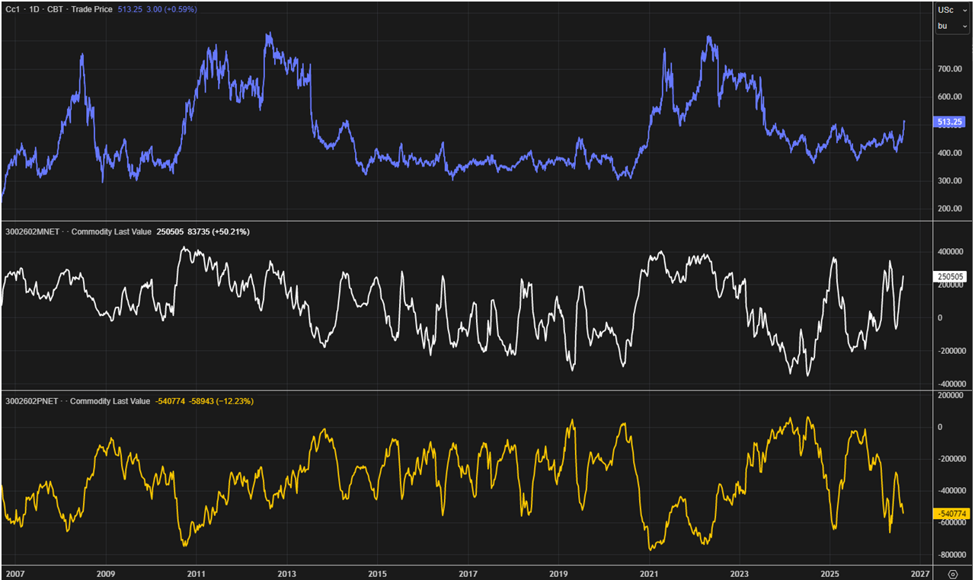
USDA delivered the corn yield cut the trade was looking for, just not as deep as the bulls wanted. Yield dropped 2.2 bpa to 178.5, and carryout fell 86 million to 1.567 billion. Both production and carryout still came in above trade expectations, though, as a 150 million cut to feed & residual absorbed much of the lost production. Wednesday's Crop Progress backed up the smaller crop: corn slipped to 56% good/excellent, 12 points behind last year. Nebraska was rated 53% good/excellent, and USDA lowered the state's yield to 177 bpa. Dec corn swung both sides of unchanged after the report and settled 1¾ lower at $5.32, down 4¾ on the week. With managed money holding a record long, harvest yields will need to confirm the smaller crop to keep that length in the market.
Beans took the harder hit. The trade expected a small yield cut, but USDA raised yield 0.1 to 52.8, putting production at a record 4.535 billion. A 25 million bump in exports trimmed carryout to 310 million, which was still above the average guess. Conditions held steady at 58% good/excellent, and Nebraska beans rated a solid 64%. Nov beans hit a contract high early in the session before reversing to settle 33¼ lower at $12.99, down 10¾ on the week. That leaves a bearish key reversal on the chart heading into next week. Demand remains the bright spot: China bought roughly 1 MMT of U.S. beans this week ahead of Xi's expected Washington visit later this month.
PLC/ARC Payment Update:
Below is link to Kansas State Ag Economics web page with per acres estimates on ARC/PLC programs by county. It is still an estimate as the final price has not been published yet (although we are past marketing year). Final prices expected to be published by the start of October and payments expected during month of October. Let us know if you we can help break down the numbers for your specific farms.
MCO:
MCO has garnered more attention with 2027 corn/soy values higher. If you want an in-depth look at the mechanics behind the product, you can watch this video. For the sake of this recap, I'm going to try and keep it as simple as possible.
· Basic function:
o Much like ECO
§ County-based (not your farm)
§ Pays out the June following harvest
o ECO and MCO BOTH will only be a 5% band in 2027. So we're talking about $40-60 of coverage. This is not a big product.
o Here is a visual for perspective:


· The idea behind "Margin" is that it helps protect against a fall in yield/price +++AND/OR+++ a rise in variable inputs (fertilizer and fuel). (see chart above)
· If inputs go up between now and April, it will be MORE likely to trigger a payment.
· If they go down, it will be LESS likely.
· HOWEVER the inputs are a very small piece of the pie. You can tell from some of the sample counties that MCO and ECO are going to pay out in similar years.
· Biggest PROS:
o A "better" price than we've had in many years
o Insulation against inflationary pressures to fertilizer and fuel
· Biggest CONS:
o You are locked into that company on SEP 30th, before we know anything about hail/wind rates, or other product offerings. (before you've even harvested 2026 crop)
o If market continues to rally, ECO could have a higher trigger.
Final thoughts: in nearly all of the counties I've sampled, MCO has a better 10-year ROI than ECO.
If you're someone who is simply looking for the best ROI product and not as concerned about private hail/wind/other products, this seems like a good buy.
If you want to have the flexibility to take hail/wind with ANY company, or products like the 95% BANDS, it's better to forgo MCO and wait until the spring to make those decisions.
Just like any insurance decision, it all comes down to YOUR risk tolerance in YOUR county. Let this serve as an intro to the conversation we can have 1-on-1. There's no way for us to say you should or shouldn't take MCO without an in-depth personal conversation.
If you want us to run your county and get in the details, give us a call to discuss.


Livestock:
Cattle put together their best week in a while. Oct fats gained $6.675 to $219.625, and Oct feeders ran $12.35 higher to $332.50. Thursday's gains came on short covering, a firmer cash tone, and stronger boxed beef movement, and cheaper corn gave feeders an extra push. Nebraska dressed bids surfaced Thursday at $340-348, while Southern sellers were asking $225 live. Steady to $1 higher bids still weren't enough to pull sellers in, with packers buying for a full week and margins remaining in the black. The feeder side was just as strong: heavy steers at Hub City in South Dakota sold $9 to $12 higher. In today's report, USDA trimmed 2026 beef production 90 million pounds on slower fed slaughter and lighter weights, but lowered the average steer price forecast $8 to $237.35.
Hogs couldn't shake last week's belly break. Bellies dropped nearly another $16 on Tuesday, and pork carcass values slipped to $91.43 on Thursday. The cash market has struggled for consistency, with packers holding the leverage and buying their needs at mostly lower prices. Oct hogs lost 62.5 cents on the week to $81.625, closing at the weekly low, which sets up some follow-through chart selling early next week. USDA also cut 2026 pork production 105 million pounds on lighter dressed weights and slower processing.
Weather:
The Corn Belt stays dry through Saturday before a wet pattern moves in. Forecasts call for 1-2 inches widely and 2-4 inches across Iowa and neighboring states September 13-17, with locally heavier totals raising flood concerns. That comes on top of nearly 6 inches in a narrow Omaha to Des Moines corridor Tuesday night that triggered flash flood warnings. With most of the corn crop made, the conversation shifts from yield to harvest timing and drying costs. The moisture should ease drought risk for immature soybeans and help wheat establishment on the Plains. Cooler air follows, with first frosts and freezes possible on the northern tier September 18-20. That is worth watching since Nebraska is one of several states still trailing average crop development. Up north, heavy rain across the Canadian Prairies is delaying harvest and raising quality risk.
Economy:
The US/Iran conflict escalated again this week. The U.S. sank five Iranian oil tankers Tuesday night, and Iran responded by claiming attacks on 10 ships in the Strait of Hormuz. CENTCOM rejected Iran's claims that it struck two Navy destroyers, and Iran-backed Houthi rebels seized a key port city on Yemen's western coast. Losing that port threatens the Red Sea route Saudi Arabia has leaned on while Hormuz stays shut. October crude settled at $102.48 Thursday, up $6.43. WTI then touched a four-month high above $104 overnight before dropping over 3% on a Financial Times report that Middle East foreign ministers are working on a temporary Hormuz shipping deal with Iran. Diesel is the number to watch heading into harvest, with U.S. stockpiles expected to drop near a 23-year low.
On the inflation front, August CPI rose 0.4% on the month and 3.4% year over year, with core prices running hotter than expected. Odds of a Fed rate hike jumped to nearly 90% after the report, with the next policy meeting this Tuesday and Wednesday. The fed funds rate has sat at 3.5-3.75% all year.
Something That Probably Means Nothing:
Fresh off a 49-21 win over Ohio, the Huskers host Bowling Green Saturday night at 6:00 on FS1 at Memorial Stadium. Nebraska is roughly a 28.5-point favorite. The Falcons' sideline might look familiar to longtime Husker fans. Head coach Eddie George, now in his second season at BG, won the 1995 Heisman Trophy with Nebraska quarterback Tommie Frazier finishing as runner-up. Thirty-one years later, the Big Red gets a shot at a little revenge. Bowling Green opened its season with a 20-13 loss to FCS Tarleton State.
Quote of the Week:
“Terrorist attacks can shake the foundations of our biggest buildings, but they cannot touch the foundation of America.” – President George W. Bush, September 11, 2001
Have a great weekend!

Comments