

2.13.26 Tredas Weekly Recap
*Special Note - Grain markets are closed Sunday night and Monday during the day for the President's Day holiday. Markets will reopen Monday night at 7pm.*
Weekly Action:
Mar26 Corn up 1.5 to $4.3175
Mar26 Beans up 17.75 to $11.33
Mar26 Chi Wheat down 0.25 at $5.4875
Mar26 KC Wheat up 11.25 to $5.425
Mar26 Cotton up 105 points to $0.6211/lb
Feb26 Hogs down $0.425 at $86.95
Feb26 Fats up $5.325 to $243.075
Mar26 Feeders down $1.275 at $366.15
Dec26 Corn up 6.75 to $4.645
Nov26 Beans up 19.5 to $11.135
July26 Chi Wheat up 7 to $5.57
July26 KC Wheat up 10 to $5.6725
Dec26 Cotton up 76 points to $0.6836/lb
Crop Insurance Price Discovery (as of 2/13) - $4.58 corn & $10.87 beans.
Current 2026 Soybean/Corn Ratio ~2.39
Grains:
This week’s corn futures have shown choppy trading with moderate gains to end the week. March corn closed Wednesday and Thursday with volume strong and open interest rising, indicating active positioning by traders in the front-month contract. A moderate increase in open interest suggests new money entering the market. New crop corn futures closing at ~4.64 have retraced most of the losses following the bearish January USDA reports. A sleepy February WASDE report left the market mostly unchanged this week.
Soybean futures reached a nine-week high following reports from Bloomberg and the South China Morning Post that the U.S/China trade truce could be extended by up to a year. Key highlights include:
Extended Truce: President Trump and President Xi Jinping may finalize a year-long extension during a planned April summit in Beijing.
Economic Wins: The summit aims to secure short-term gains, specifically through renewed Chinese commitments to purchase American agricultural products.
Soybean Surge: Markets rallied on news that China is considering increasing its soybean purchases to 20 million tons for the current season.
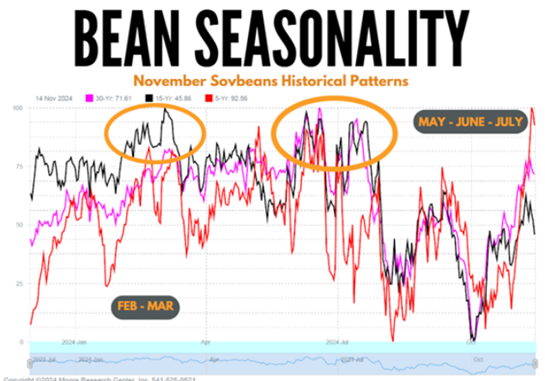
Seasonally, soybeans are strong into the last part of February through the beginning of March, with a majority of the seasonality falling in May-June-July for the US growing season. See the US soybeans seasonal chart below.
Wheat also saw some strength, showing solid gains on Thursday as traders reacted to export news and spillover support from other grains.
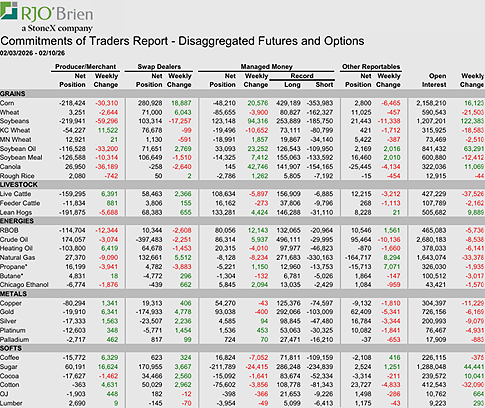
CFTC Commitment of Traders Report Summary of Fund Positions:
Livestock:
Cattle markets were mixed with slight softness at week’s end, and hogs continued a drifting lower pattern amid weak demand signals. While packer margins are at a historically tight period, we have seen some positive basis movement in the past few days. Cash feeders continue to trade at values well above-board with no sign of slowing down apparent in trade.
Economy:
The big economic story this week was the release of the January jobs report, which showed stronger-than-expected payroll growth. The month of January showed about 130,000 new jobs added, and a drop in the unemployment rate to around 4.3%. This surprise to the upside signals that the labor market remains resilient despite concerns about slowing job creation late last year and has tempered expectations for near-term Federal Reserve rate cuts. Traders and economists now see less urgency for the Fed to reduce borrowing costs soon, given the strength in hiring.
January inflation cooled more than anticipated, with the Consumer Price Index rising about 2.4% year-over-year, its slowest pace in nearly five years and close to the Federal Reserve’s 2% target. Energy and housing cost gains eased, helping moderate overall price pressures. This softer inflation print gives policymakers some confidence that price growth is moving in the right direction — though inflation remains above pre-pandemic norms.
U.S. stock markets responded positively to the cooling inflation data, with major indexes rising on Friday after the CPI release, though broader market sentiment remains cautious amid uncertainty over Fed policy and economic growth prospects.
Something That Probably Means Nothing:
At the 1912 Summer Olympics, gold medals were made of actual solid gold, marking the only time in Olympic history that happened.
The 1912 Games were held in Stockholm, Sweden, and those medals were comprised of 24-karat gold. After 1912, rising gold costs led organizers to switch to gold-plated silver instead, which is what modern Olympic “gold” medals are actually made of today.
Quote of the Week:
“To uncover your true potential, you must first find your own limits and then have the courage to blow past them.” – Picabo Street (Former USA Alpine Skier)
Have a great weekend!
