10.30.26 Tredas Weekly Recap
Weekly Action:
Dec26 Corn down 8.25 at $4.4775
Nov26 Beans down 35.25 at $12.2225
Dec26 Chi Wheat down 21.5 at $6.035
Dec26 KC Wheat down 19.75 at $6.4425
Dec26 Cotton down 244 points at $0.7783/lb
Dec26 Hogs down $6.7 at $58.875
Dec26 Fats down $10.175 at $220.95
Nov26 Feeders down $10.35 at $337.775
Dec27 Corn down 7.5 at $4.875
Nov27 Beans down 22 at $12.09
Jul27 Chi Wheat down 16.5 at $6.2975
Jul27 KC Wheat down 18 at $6.625
Dec27 Cotton down 190 points at $0.7735/lb
ARC/PLC Reminder:
We’d like to remind everyone to make program elections for 2026 ARC /PLC by the 12/11/26 deadline. If you do not make an election, you will be ineligible for payments. Generally speaking, the following is how we’d recommend you select a program for 2026:
Average/Below-Average County Yield = ARC County
Above Average County Yield = PLC
Below is a link to our ARC/PLC analysis tool where you can test price/yield scenarios in your specific county(s). ***ARC-Individual is being considered for 2026 considering we get a “look-back” at yields. If you have farms that dramatically under-performed your personal averages & county expectations, ARC-Individual may be worth looking at. Please give your broker/agent a call to discuss further.

Grains:
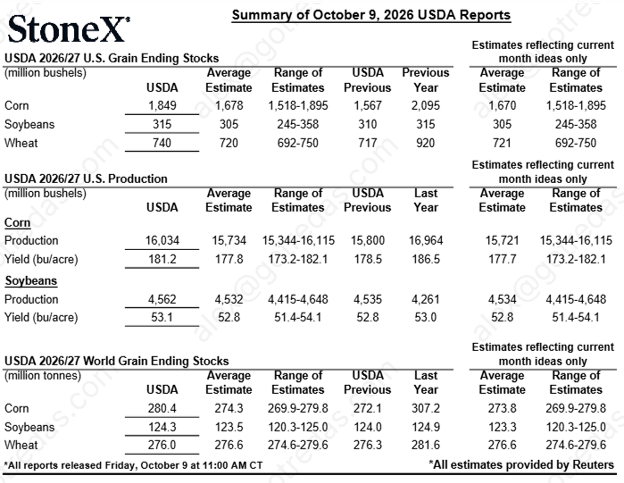
Grain markets remain pressured as harvest continues & large USDA yield figures loom. The corn market’s steady bleed seemed to slow this week but still struggles to find footing. We’re getting mixed signals from corn export demand as weekly export sales were ahead of the four-week average, but export inspections were well below this time last year. Another headline item was USDA’s corrections to the September WASDE report for Nebraska & Kansas. In a Friday afternoon memo, USDA announced a processing error resulting in after-the-fact yield adjustments for Nebraska & Kansas corn. NE yield was increased 5bpa to 182, while KS was dropped 3bpa to 119. The overall US corn yield saw a slight increase of 0.3bpa to 178.8 for September. Despite having little effect on markets, the corrections added fuel to the reliability-concerns regarding USDA estimates. Going forward, corn will need a boost to demand and/or evidence of a smaller crop to overcome it's now heavier balance sheet.
The soybean market has seen similar action to corn with it’s inability to find traction. However, the export scene has been a bright spot with inspections reaching levels substantially above this time last year. China has been the bulk of that, which is a nice change from last year. The major concern this week was bearish action in the Brazilian Real market following the re-election of President Lula. Considering they’re our largest competitor in the global soybean market, cheaper Brazilian soybeans doesn’t bode well for US export opportunities. The main question for soybeans (outside of US crop size) is whether strong demand prospects can hold up & provide support for the market looking ahead.
Wheat managed to bounce slightly headed into the weekend thanks to a positive export sales report. Last week’s US wheat sales were the highest weekly total since June, resulting in the first positive close since 10/14. Otherwise, geopolitical tensions continue to own wheat headlines as Russia & Ukraine continue to exchange blows. The combo of oversold technical indications, ongoing Black Sea uncertainty, & recent life in the US export market could make wheat particularly sensitive to fresh headlines.
Livestock:
Cattle markets, especially live cattle, struggled this week as traders questioned whether cash & fundamental factors support a continued rally. Thursday & Friday alone took roughly $10 out of live/feeder futures. Now, the underlying supply picture remains supportive as we saw in last Friday’s COF report. Cattle on feed is in line with last year, but placements & marketings are either side of 10% below last year. The big-picture fundamentals remain unchanged; however, cattle markets are facing selling pressure following a strong Sep-Oct rally & softer cash values.
Lean hogs saw similar selling pressure to cattle but unfortunately aren’t coming off a two-month rally. The hog market has struggled to find support amid weakening cash & pork values. Without improvement in these areas, the hog market will continue to battle pressures, despite being due for a technical correction.
Weather:
US weather has been favorable for harvest the past week, allowing for solid progress & catchup from earlier delays. This week’s Crop Progress data shows US corn 60% harvested (slightly behind avg. pace) and US soybeans 79% harvested (slightly ahead avg. pace). Unfortunately, wetter forecasts into next week may bring further delays as many areas try to wrap up harvest. Scattered thunderstorms are predicted for many areas of the Plains, Midwest, & Delta. Wind gusts up to 40mph are expected across parts of these regions, with potential for even stronger gusts in parts of the Central Plains. This is especially concerning due to the questionable stalk quality in corn. We’ve seen first-hand the havoc late wind can cause, as many areas in Nebraska have a significant amount of ears on the ground. In certain irrigated areas, as much as 50bu.

Economy:
Third-quarter GDP surprised to the upside, suggesting economic active remains resilient despite ongoing inflation concerns. Consumer spending continues to be an important driver, although there are questions about whether that’s sustainable. Inflation continues to outpace income growth which means households may be relying more heavily on savings or credit to maintain spending levels. Reuters recently reports that markets are increasingly pricing in the possibility of another interest-rate hike which isn’t ideal for the ag-input conversation. The situation is ever-evolving but the challenge to bring inflation under control continues.
Something That Probably Means Nothing:
Halloween actually has agricultural roots. The holiday can be traced back to an ancient Celtic festival called Samhain (pronounced "sow-in"), which marked the end of harvest and the beginning of winter. It was a time when crops were gathered, livestock were brought in from summer pastures, and communities prepared for the colder months ahead. Celebrations included bonfires and feasts, along with traditions tied to the belief that spirits could cross into the living world. So while Halloween today is mostly about costumes, candy, and pumpkins, it originally had a lot more to do with wrapping up harvest and preparing for winter.
Quote of the Week:
"The happiness of your life depends upon the quality of your thoughts." — Marcus Aurelius
Have a great weekend!


Comments