5.29.26 Tredas Weekly Recap
Weekly Action:
Jul26 Corn down 16.5 at $4.4675
Jul26 Beans down 9.75 at $11.8675
Jul26 Chi Wheat down 35.75 at $6.105
Jul26 KC Wheat down 32.25 at $6.4975
Jul26 Cotton down 127 points at $0.7615/lb
June26 Hogs up $0.1 to $95.85
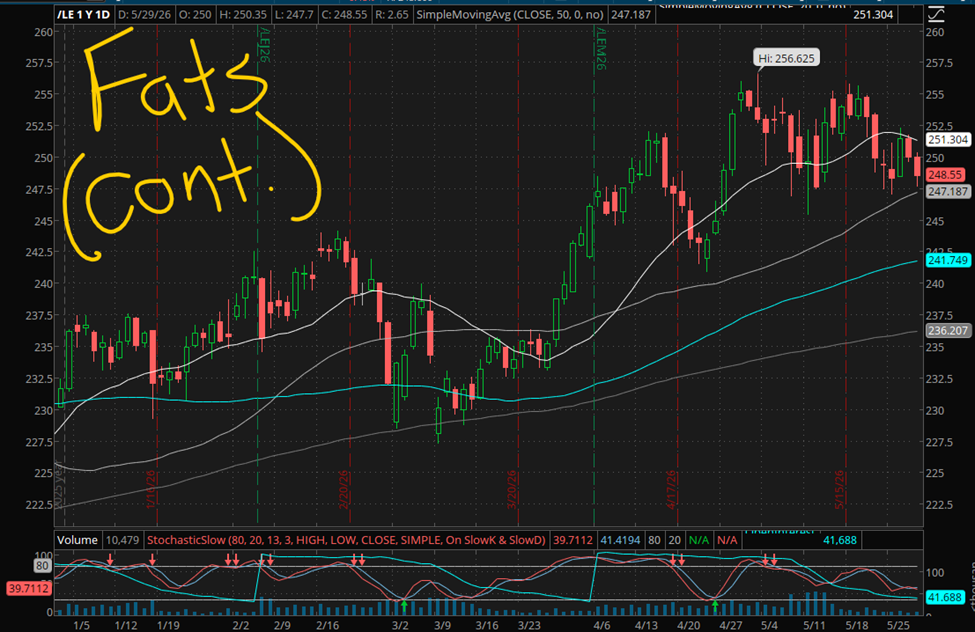
June26 Fats down $1.05 at $248.25
Aug26 Feeders down $1.425 at $348.425
Dec26 Corn down 11.5 at $4.75
Nov26 Beans up 2.25 to $11.9
Sep26 Chi Wheat down 35.75 at $6.235
Sep26 KC Wheat down 31.75 at $6.615
Dec26 Cotton up 26 points to $0.7959/lb
Grains:
· Corn, beans, and wheat leaned lower on end-of-month long liquidation as the market priced in an Iran peace deal. Dec corn leaning on 200-day MA, support below here would be the mid-April lows of 470. Bulls need fed!!!

· I do think it’s important to note how resilient the bean chart has been despite the significant corn pullback:

· Export sales mixed: old crop corn 1.015 MMT (40.0 mil bu), bottom of expectations but crop year commitments still 26% ahead of last year at 3.184 bil bu. Beans 300k tonnes (11.0 mil bu), in line. Wheat saw old crop cancellations roll into new crop.
· USDA flashed 192k tons of beans to unknown (60k old / 132k new) — a small bit of demand to lean on.

Livestock:
· Cattle got hit hard — live and feeders followed Thursday’s weak close lower. New World Screwworm case 52 miles from Texas, the closest US detection yet.
· Two labor stories: Cargill’s Fort Morgan, CO plant stays in limbo after talks failed this week — lockout continues, and the packer has little reason to settle while losing money. Dodge City, KS workers signed instead of striking, giving some relief.
· Market note: new daily limits Monday — fats $8.50, feeders $10.75.
· Hogs failed again — sharply lower in sympathy with cattle, can’t hold gains past a day. Interesting with beef triple the price of hogs, but global demand stays soft for now.
Weather:
· Midday GFS trending wetter for the Plains and NW Midwest. “An Omega block in the polar jet breaks down into a subtropical ridge building north out of the Rockies around June 7th.”
· How’s that for a mouthful of weather-man jargon? In simple words, this is what they expect for precipitation for the next 240 hours (10 days).

· You will likely hear a lot about the “super El Nino” developing. To try and summarize it simply:
A super El Niño is an unusually strong warming of the equatorial Pacific, and it tends to reshuffle weather across the major growing regions: drier and hotter across India, Southeast Asia, and Australia — which pressures palm oil, rice, and Indian oilseed crops — while South America (Argentina and southern Brazil) often leans wetter and more favorable. For the US, it usually means a milder, sometimes wetter pattern. We're already seeing the front end of it: India's monsoon is projected at 90% of average, the worst in 11 years. The watch items for our markets are an Asian vegoil supply squeeze, the South American crop outlook, and whether India's reservoirs refill enough to protect their 2027 wheat crop.

Economy:
· Market’s trading on a peace accord — Trump lifted the naval blockade but it still awaits his and Iran’s signatures. Deal extends the ceasefire 60 days and negotiates the nuclear program in that window.

· WTI below $90, lowest since mid-April. A deal could push spot into the upper $70s–low $80s.

Something That Probably Means Nothing:
The CBOE Volatility Index is as low as it’s been since the start of the year, prior to the conflict with Iran. “The VIX is the market's "fear gauge." It measures how much volatility traders expect in the S&P 500 over the next 30 days, derived from the prices people are paying for options.”

Quote of the Week:
"People curse anyone who hoards grain, but a blessing will come to the one who sells it." Proverbs 11:26 (CSB)


Comments